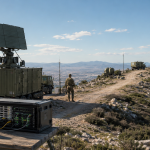
How RF over Fiber Enables Secure Remote Antenna Placement in Defense Facilities
The Hidden Risk in Traditional RF Architecture
In many military communication systems, antennas are installed directly above or adjacent to core communication rooms. While this simplifies deployment, it creates a critical vulnerability.
Coaxial cable runs tie exposed antenna infrastructure directly to sensitive equipment-modems, encryption units, and control systems. This tight coupling increases the risk of:
- Physical targeting
- Signal interception
- Electromagnetic leakage
In modern RF military and defense environments, this architecture is increasingly seen as outdated.
RF over Fiber: The Foundation of Secure RF Infrastructure
RF over Fiber (RFoF) changes how defense facilities are designed.
Instead of transmitting RF signals over coaxial cables, RFoF converts them into optical signals and transmits them over fiber. This enables antennas to be placed far from core systems-without signal degradation.
More importantly, it enables a secure, distributed architecture that is rapidly becoming standard in advanced defense RF solutions.
1. True Physical Separation of Critical Assets
With RF over Fiber, antennas can be deployed hundreds of meters-or even kilometers-away from sensitive infrastructure.
This creates:
- Clear physical separation between exposed RF endpoints and secure processing systems
- Reduced blast or attack impact radius
- Independent hardening strategies for antenna sites vs. control rooms
Unlike coax, which suffers from signal loss over distance, RFoF maintains signal integrity-making separation practical without compromise.
2. Eliminating RF Signal Leakage Paths
Traditional coaxial cables can act as unintended antennas, leaking signals and increasing interception risk.
RF over Fiber eliminates this problem:
- Fiber does not radiate electromagnetic signals
- Signals are contained within the optical domain
- No exploitable RF leakage along transmission paths
For military RF solutions, this significantly reduces the attack surface for signal intelligence (SIGINT) threats.
3. Strengthening Electromagnetic Security (EMSEC)
EMSEC is a critical requirement in defense communication systems.
By using RF over Fiber, facilities can:
- Remove RF signals from secure zones entirely
- Prevent unintended emissions from cabling infrastructure
- Maintain strict electromagnetic isolation between zones
This makes RFoF a powerful tool for meeting stringent EMSEC standards in high-security environments.
4. Enabling Distributed and Resilient Architectures
RF over Fiber makes it easy to design distributed antenna systems:
- Multiple remote antenna sites can be connected to a central facility
- Redundant paths can be established for failover
- Antennas can be geographically dispersed to reduce single points of failure
This level of flexibility is essential in modern defense RF solutions, where uptime and survivability are mission-critical.
5. Improving Performance While Increasing Security
Unlike many security measures, RF over Fiber enhances performance:
- Supports wideband and high-frequency signals (including L-band and beyond)
- Eliminates signal loss associated with long coaxial runs
- Enables optimal antenna placement for line-of-sight and coverage
This means defense organizations no longer have to choose between performance and protection-RFoF delivers both.
6. Supporting Advanced Military Communication Systems
As military communication systems evolve to support:
- SATCOM
- GPS/GNSS distribution
- Tactical radio networks
The need for flexible, secure RF transport becomes critical.
RF over Fiber provides a unified infrastructure that can support multiple signal types across a single fiber backbone-simplifying deployment while enhancing security.
Design Considerations for RF over Fiber Deployment
To fully leverage RF over Fiber in RF military and defense environments, planners should consider:
- Secure fiber routing and redundancy
- Environmental protection of remote antenna units
- Power availability at remote sites
- Integration with existing defense communication systems
Properly implemented, RFoF becomes the backbone of a secure RF architecture-not just a transport medium.
RF over Fiber as a Security Strategy
In today’s threat landscape, infrastructure design is a frontline defense.
RF over Fiber enables remote antenna placement that dramatically reduces vulnerability, limits signal exposure, and strengthens electromagnetic security-while simultaneously improving RF performance.
For organizations deploying next-generation military RF solutions and defense communication systems, RFoF is not just an upgrade, it’s a strategic necessity.