How GPS Coverage is Extended Inside Buildings and Enclosed Spaces
Imagine a maintenance crew working inside an aircraft hangar. Outside, navigation systems lock instantly onto satellite signals. But once the aircraft is pulled indoors, GPS drops out completely. For teams relying on positioning, timing, or synchronization, that loss of signal isn’t just inconvenient it can disrupt operations.
This is a common challenge across many environments: large buildings, underground facilities, tunnels, and secure bunkers. GPS and GNSS signals are inherently weak by the time they reach Earth, and structures made of concrete, steel, or composite materials block them almost entirely. So how do you maintain continuous positioning indoors?
Bringing GPS Indoors: The Basic Idea
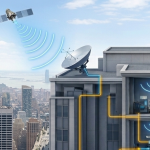
The solution is simpler than most people expect. Instead of trying to generate GPS signals inside a building, systems are designed to capture them outside where they are strong and extend them indoors. This is where GPS repeaters (also known as GNSS repeaters) come into play.
A typical setup works like this:
- An outdoor antenna is placed in a location with clear sky visibility
- It receives live GPS/GNSS satellite signals
- These signals are then transported into the building
- Indoor antennas rebroadcast the signal locally
The result: devices inside the structure behave as if they are still outdoors, maintaining lock on satellite signals without interruption.
Extending Coverage Without Complexity
Modern GPS signal repeater systems are designed to extend coverage cleanly and reliably, without introducing noise or distortion. One increasingly common approach uses GNSS GPS fiber solutions, where signals are transported over fiber instead of traditional coaxial cable.
Why does that matter?
- Distance: Fiber enables signals to travel much farther without degradation
- Signal Integrity: Maintains accurate timing and positioning data
- Flexibility: Ideal for large or complex environments like campuses or multi-level facilities
This makes solutions, such as an indoor GPS repeater or a GPS repeater for hangar, particularly effective in scenarios where coverage must span long distances or multiple zones.
Where Indoor GPS Coverage Matters
Extending indoor GPS coverage isn’t just a technical upgrade. It enables real operational continuity. Common use cases include:
- Aircraft hangars: Supporting navigation system testing and maintenance
- Military and defense sites: Ensuring GPS availability in secure or underground locations
- Warehouses and logistics hubs: Enabling asset tracking and automation
- Research labs and testing facilities: Providing controlled GNSS environments
In all of these cases, the goal is the same: seamless transition between outdoor and indoor environments, with no loss of signal or performance.
Why Continuity Is Critical
Many systems today rely on uninterrupted GPS not just for positioning, but for timing synchronization and operational coordination. When a signal drops, it can affect:
- Equipment calibration
- Network synchronization
- Safety systems
- Testing accuracy
By using a GPS repeater, organizations ensure that GPS-dependent systems continue to function exactly as expected, regardless of location.
Maintaining GPS access shouldn’t stop at the building entrance. With the right approach, organizations can extend reliable satellite coverage indoors, ensuring continuity, accuracy, and performance wherever it’s needed.
Frequently Asked Questions (FAQs)
Can GPS work inside buildings without assistance?
Generally, No. GPS signals are too weak to penetrate most building materials effectively, especially in dense or enclosed environments.
What is a GPS repeater?
A GPS signal repeater captures live satellite signals outdoors and retransmits them indoors, enabling GPS-enabled devices to function inside buildings.
Is there a difference between GPS and GNSS repeaters?
Yes. GPS refers specifically to the U.S. system, while GNSS includes multiple global systems (like Galileo or GLONASS). GNSS repeaters can handle multiple constellations.
How is signal quality maintained indoors?
High-quality systems especially those using gnss gps fiber solutions preserve signal integrity over long distances, ensuring accurate positioning and timing.
Can I use a GPS repeater in a hangar or underground facility?
Yes. Solutions like a GPS repeater for hangar are specifically designed for large, enclosed spaces and can extend coverage effectively even below ground.
Do indoor GPS repeaters require complex installation?
Not necessarily. Most systems are modular and designed for straightforward deployment, with scalability depending on the size and layout of the facility.