

Monthly Archives: February 2026

Challenges of Moving L-Band Signals Across Large Ground Facilities

Challenges of Moving L-Band Signals Across Large Ground Facilities

Satellite earth stations and teleports are expanding. As demand grows for higher throughput, multi-orbit support, and diversified services, antennas are often positioned hundreds of meters – sometimes kilometers – away from control rooms, modems, and baseband processing equipment.

While this layout improves operational flexibility, it creates a persistent engineering challenge: how to transport L-band signals across large facilities without degrading performance.

Why L-Band Signals Struggle Over Distance

L-band (typically 950–2150 MHz in satellite IF systems) is widely used to carry intermediate frequency signals between outdoor antenna systems and indoor equipment. On paper, it seems manageable. In practice, long-distance transport introduces several issues:

1. Signal Attenuation

Coaxial cable loss increases with frequency and distance. Over long runs, attenuation can become significant, requiring additional amplification stages. Each amplifier adds cost, power requirements, and potential distortion.

2. Noise Figure Degradation

In satellite communications, maintaining a low noise figure is critical. Long coax runs increase insertion loss before the signal reaches sensitive indoor equipment, effectively degrading the system’s overall performance and reducing link margin.

3. Limited Scalability

Large ground stations often support multiple antennas, multiple polarizations, and multiple frequency bands. Scaling coax-based infrastructure means pulling more heavy cable bundles through ducts and trays – increasing complexity, weight, and maintenance burden.

4. Electromagnetic Interference (EMI)

Ground facilities can contain high-power transmitters, switching systems, and other RF equipment. Copper-based transport is susceptible to EMI and grounding issues, which can introduce instability or performance inconsistencies.

5. Infrastructure Constraints

Long coaxial runs are bulky, heavy, and expensive to install. As facilities expand, cable management becomes a serious operational constraint, particularly in teleports serving commercial broadcast, mobility, defense, and gateway services.

The Shift Toward Optical-Based RF Transport

To overcome these limitations, many operators are turning to rf over fiber technology as the backbone of their L-band distribution architecture.

Rather than transmitting RF signals over copper, rfof systems convert electrical RF signals into optical signals, transport them over fiber, and then convert them back to RF at the destination. The result is dramatically lower signal loss over long distances.

Why Fiber Changes the Equation

1. Minimal Signal Loss Over Distance

Optical fiber introduces extremely low attenuation compared to coax. Signals can travel kilometers without the need for intermediate amplification, preserving signal integrity and improving overall system noise performance.

2. Immunity to EMI

Fiber is non-conductive and immune to electromagnetic interference. In dense RF environments like teleports, this provides consistent, predictable performance.

3. Reduced Weight and Footprint

Fiber is lighter, thinner, and easier to route than large coax bundles. This simplifies infrastructure expansion and reduces structural load.

4. Scalability for Modern Ground Stations

As facilities evolve to support multi-orbit constellations (GEO, MEO, LEO) and higher antenna counts, rf over fiber solutions provide a scalable architecture. Additional links can be deployed without major physical infrastructure changes.

Maintaining Performance Across Expansive Layouts

Performance consistency is critical in satellite operations. Variations in gain, phase, or noise can affect service quality, especially for high-throughput satellites and sensitive GNSS applications.

High-quality rf over fiber products are engineered to provide:

  • Wide dynamic range
  • Excellent linearity
  • Low phase noise
  • Stable gain over temperature

This ensures that even as facilities expand, signal integrity remains predictable and reliable.

Future-Proofing Teleports and Earth Stations

As satellite communications continues to evolve – driven by broadband demand, mobility services, and defense applications – ground infrastructure must adapt.

Traditional coax-based L-band transport struggles to scale efficiently across large, modern facilities. In contrast, optical-based RF transport offers:

  • Long-distance performance without degradation
  • Infrastructure simplification
  • Operational flexibility
  • Improved reliability

For operators designing next-generation teleports or upgrading legacy earth stations, integrating rf over fiber solutions as a core transport layer is no longer just an optimization – it is becoming a necessity.

By replacing distance-limited copper runs with fiber-based RF distribution, ground facilities can maintain consistent L-band performance across expansive layouts while preparing for the demands of tomorrow’s satellite networks.
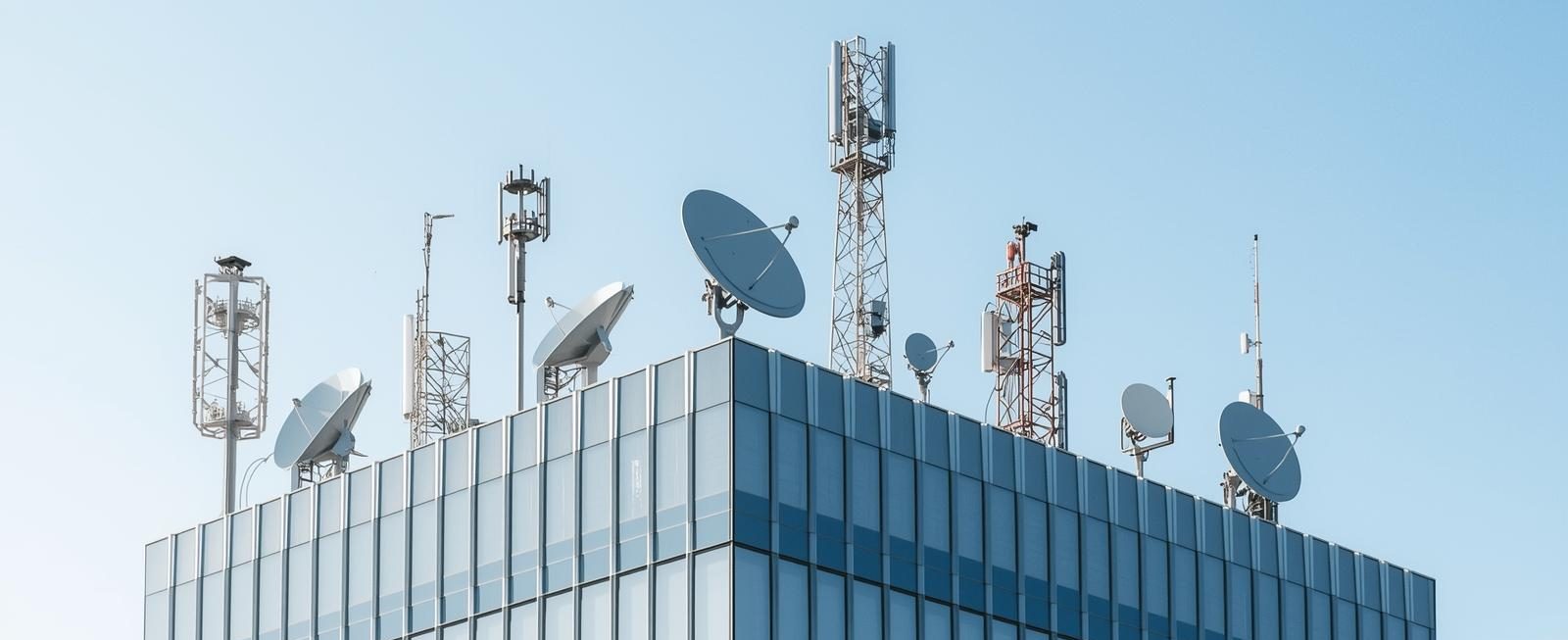

Connecting Antennas and Remote Equipment in Defense, Cellular, and Satellite Networks

Connecting Antennas and Remote Equipment in Defense, Cellular, and Satellite Networks

Modern defense, cellular, and satellite systems demand far more flexibility than traditional RF infrastructure can easily support. Antennas are often placed far from control rooms, baseband units, or signal processing equipment-on towers, rooftops, perimeter zones, underground facilities, or remote sites. As distances increase and environments become more challenging, legacy copper-based connections struggle to deliver reliable performance.

This is where RF over fiber (RFoF) has become a critical enabling technology.

The Challenge of Long-Distance RF Transport

In military bases, cellular networks, and satellite ground stations, antenna placement is driven by coverage, security, and line-of-sight not by proximity to equipment rooms. Coaxial cable, while familiar, introduces several limitations:

• Significant signal loss over distance
• Increased sensitivity to EMI and lightning
• Heavy, bulky cabling that complicates installation
• Limited scalability as frequency demands grow

For high-frequency, multi-band, or mission-critical systems, these issues can directly impact performance and reliability.

Why RF over Fiber Is Gaining Ground

RF over fiber solutions transport RF signals by converting them to optical signals and sending them over standard fiber optic cable. This approach dramatically improves system design flexibility while preserving RF performance.

Key advantages include:

  • Near-zero attenuation over long distances
  • Complete immunity to electromagnetic interference
  • Lightweight, compact cabling ideal for dense or remote deployments
  • Wide frequency support, from IF to microwave and beyond

These benefits make RFoF especially well suited for defense, cellular, and satellite environments where signal integrity and uptime are critical.

Industry-Specific Applications

Defense and Secure Installations

Military and government systems often require physical separation between antennas and sensitive equipment for security and survivability. RFoF applications enable antennas to be deployed at optimal locations-perimeters, masts, or hardened zones while keeping processing equipment safely centralized. Fiber also reduces the risk of interception and interference.

Cellular and Private Wireless Networks

Modern cellular deployments, including DAS, small cells, and private LTE/5G networks, rely on centralized baseband architectures with distributed radio points. RF over fiber solutions simplify these designs by enabling long, clean RF links without performance degradation, even across large campuses or urban environments.

Satellite Ground Stations

Satellite communication systems depend on precise, low-noise RF transport between antennas and indoor equipment. Fiber-based RF links maintain signal fidelity across wide bandwidths, making RF over fiber products ideal for connecting remote antennas, tracking systems, and teleport infrastructure.

Simplifying Infrastructure While Preserving Performance

One of the biggest advantages of RF over fiber is infrastructure simplification. By replacing long coax runs with fiber, organizations can:

  • Reduce the need for amplifiers and repeaters
  • Lower maintenance and lifecycle costs
  • Improve system reliability in harsh environments
  • Future-proof networks as frequency requirements evolve

For mission-critical systems, fewer components in the RF path mean fewer points of failure.

A Proven Path Forward

As defense, cellular, and satellite networks continue to expand in scale and complexity, the limitations of traditional RF cabling become harder to ignore. RF over fiber solutions provide a mature, field-proven way to extend RF signals over long distances without compromising quality.

With a growing ecosystem of specialized RF over fiber products, RFoF is no longer a niche technology-it is a strategic tool for building secure, scalable, and high-performance wireless infrastructure.

How High-Frequency Signals Are Transported Over Long Distances

How High-Frequency Signals Are Transported Over Long Distances

High-frequency (HF) and radio-frequency (RF) signals are the backbone of modern communication systems. From cellular networks and satellite links to broadcast and navigation systems, these signals must often travel long distances while preserving signal integrity. That’s easier said than done.

As frequencies increase, so do the challenges. Traditional transport methods struggle to maintain signal quality, reliability, and efficiency over distance. This is where RF over fiber has emerged as the practical and scalable solution.

The Challenge of Transporting High-Frequency Signals

High-frequency signals are especially vulnerable to degradation during transport. When RF signals are carried over conventional copper or coaxial cables, several issues arise:

  • Signal attenuation increases rapidly with frequency and distance
  • Electromagnetic interference (EMI) degrades signal quality
  • Limited reach requires frequent amplification or regeneration
  • Bulky, heavy cabling adds cost and complexity
  • Ground loops and lightning exposure threaten system reliability

These limitations make long-distance RF transport inefficient and expensive, particularly in environments such as large facilities, campuses, tunnels, airports, or satellite ground stations.

Why Fiber Changes the Equation

Fiber-optic cable was originally adopted for digital data transport, but it has proven equally powerful for analog RF signals. By converting RF signals into optical signals, fiber enables transport over tens – even hundreds – of kilometers with virtually no degradation.

This approach, commonly known as RF over fiber (RFOF), eliminates many of the constraints of traditional cabling.

Key advantages include:

  • Ultra-low signal loss over long distances
  • Immunity to EMI and lightning
  • Lightweight, compact cabling
  • Wide frequency support, from kHz to multi-GHz
  • High signal fidelity without repeated amplification

Because fiber does not radiate or pick up interference, it is ideal for mission-critical RF systems where stability and accuracy are essential.

What Is RF over Fiber?

RF over fiber refers to the process of modulating an RF signal onto an optical carrier, transmitting it through fiber-optic cable, and then converting it back to RF at the destination.

An RFOF system typically consists of:

  • An optical transmitter that converts RF to light
  • Single-mode or multi-mode fiber for transport
  • An optical receiver that converts light back to RF

These systems are designed to preserve the original signal characteristics — including phase, amplitude, and timing — making them suitable for both analog and digital RF applications.

RFOF Applications Across Industries

Today, RFOF applications span a wide range of industries and use cases:

  • Telecom networks: Transporting cellular and 5G signals between remote radio heads and centralized baseband units
  • Satellite communications: Linking antennas to indoor equipment shelters over long distances
  • Broadcast systems: Distributing RF signals to multiple transmission points
  • Navigation and timing: Carrying GNSS and timing signals with minimal phase noise
  • Defense and aerospace: Secure, interference-free RF transport

In each case, RF over fiber solutions provide flexibility, scalability, and performance that traditional methods cannot match.

RF Over Fiber Solutions in Modern Systems

Modern RF over fiber solutions are engineered to support wide frequency ranges, high dynamic range, and low noise figures. Many systems are modular, allowing operators to scale from a single RF link to complex, multi-channel architectures.

Advanced designs also support:

  • Bidirectional RF transport
  • Multiple frequency bands on a single fiber
  • Long-haul and campus-scale deployments
  • Redundant and hardened configurations

These capabilities make RFOF a foundational technology in today’s converged RF and optical networks.

Choosing the Right RF Over Fiber Products

Selecting the right RF over fiber products depends on several factors:

  • Frequency range and bandwidth
  • Required link distance
  • Signal type (analog, digital, GNSS, IF, RF)
  • Environmental conditions
  • System redundancy and monitoring needs

High-quality RFOF systems are designed to operate continuously with minimal maintenance, ensuring reliable RF transport even in harsh or remote environments.

The Future of High-Frequency Signal Transport

As networks continue to densify and frequencies climb higher, the demand for clean, stable RF transport will only increase. Fiber-based transport is no longer an alternative – it is the standard.

By overcoming the physical limitations of copper and coax, RF over fiber enables modern telecom, satellite, and broadcast systems to scale efficiently without sacrificing performance.

In short, when high-frequency signals need to go far, RFOF is the technology that makes it possible.