
Monthly Archives: June 2026

Why Indoor Satellite Communication Fails in Critical Facilities – And How to Design Around It

Why Indoor Satellite Communication Fails in Critical Facilities

In mission-critical environments, communication failures are more than an inconvenience. Whether supporting emergency response teams, maintaining operations in underground facilities, coordinating industrial activities, or ensuring continuity in secure government installations, reliable connectivity is essential.

Satellite communication systems, such as Iridium and Inmarsat, provide global reach and independence from terrestrial networks, making them essential for emergency response, defense operations, critical infrastructure, transportation, and industrial facilities. However, organizations often discover that maintaining reliable indoor satellite communication is far more challenging than achieving coverage outdoors. Signals that perform well outdoors can become weak, inconsistent, or completely unavailable once they encounter complex building environments.

Understanding why indoor satellite communication fails is the first step toward designing infrastructure that delivers dependable coverage where it is needed most.

Different Satellite Networks Face Similar Indoor Challenges

Whether an organization relies on Iridium, Inmarsat, or satellite-enabled GPS infrastructure for positioning, timing, or communications, indoor environments create many of the same challenges. These systems depend on signals arriving from outside the facility, making them vulnerable to attenuation caused by reinforced construction materials, underground locations, and complex industrial layouts. As facilities become more secure and more structurally complex, maintaining reliable satellite communication indoors requires purpose-built distribution infrastructure rather than direct signal reception alone.

Why Satellite Signals Struggle Indoors

Satellite networks, such as Iridium, rely on direct communication between user equipment and satellites in orbit. Unlike terrestrial wireless systems that can be supported by nearby towers and dense infrastructure, satellite signals must penetrate the physical environment before reaching the end user. This creates significant challenges inside critical facilities.

Reinforced Structures Block Signal Paths

Many mission-critical sites are intentionally designed with dense construction materials that provide physical security and environmental protection. Reinforced concrete, steel frameworks, blast-resistant walls, and specialized shielding can significantly attenuate satellite signals. As signals pass through these materials, their strength decreases, reducing communication reliability and increasing the likelihood of dropped connections.

Underground Facilities Have Limited Visibility to Satellites

Command centers, transportation tunnels, utility infrastructure, mining operations, and secure underground facilities often operate entirely outside the direct line of sight required for satellite communication. Without a clear path to the satellite constellation, communication devices may be unable to establish or maintain a connection at all.

Industrial Environments Create Additional Obstacles

Large industrial facilities present unique challenges for satellite communication indoors. Heavy machinery, storage systems, metal structures, process equipment, and constantly changing operational layouts can create signal shadowing and unpredictable coverage gaps. Even locations that initially appear to have adequate signal strength may experience inconsistent performance as equipment and operating conditions change over time.

Secure Operational Environments Prioritize Protection Over Coverage

Facilities designed for defense, government, emergency management, or critical infrastructure often prioritize physical security, redundancy, and resilience. While these design objectives are essential, they frequently create environments where satellite signals cannot naturally penetrate. As a result, communication coverage becomes a design challenge rather than an automatic capability.

Common Infrastructure Challenges

Physical obstruction is only part of the problem. Many indoor communication failures stem from infrastructure decisions made during facility design or expansion.

Poor Signal Routing

Bringing satellite connectivity indoors requires more than simply placing an antenna outside a building. Signal paths must be carefully engineered to ensure sufficient signal quality reaches operational areas without excessive losses. Long cable runs, multiple connection points, and inefficient routing can significantly degrade performance.

Weak Coverage Zones

Facilities often contain areas where communication is especially important but particularly difficult to reach. Control rooms, maintenance areas, equipment shelters, underground spaces, and remote sections of large buildings frequently become communication dead zones. Without a structured distribution strategy, these weak coverage zones can remain undetected until communication is needed during a critical event.

Antenna Placement Issues

Antenna location has a direct impact on system performance. Outdoor antennas require clear visibility to the satellite network, while indoor coverage antennas must be positioned to provide consistent signal distribution throughout operational spaces. Poor antenna placement can create uneven coverage, reduce system efficiency, and limit the effectiveness of indoor satellite communication solutions.

Infrastructure Scalability Limitations

Many facilities evolve over time. New operational areas are added, buildings expand, and communication requirements grow. Systems designed without scalability in mind often struggle to maintain performance as infrastructure becomes more complex.

Designing Around Indoor Satellite Communication Challenges

Successful indoor satellite communication depends on treating coverage as an infrastructure design challenge rather than an equipment challenge. A structured signal distribution architecture enables satellite signals to be captured where reception is optimal and delivered to the locations where users actually work.

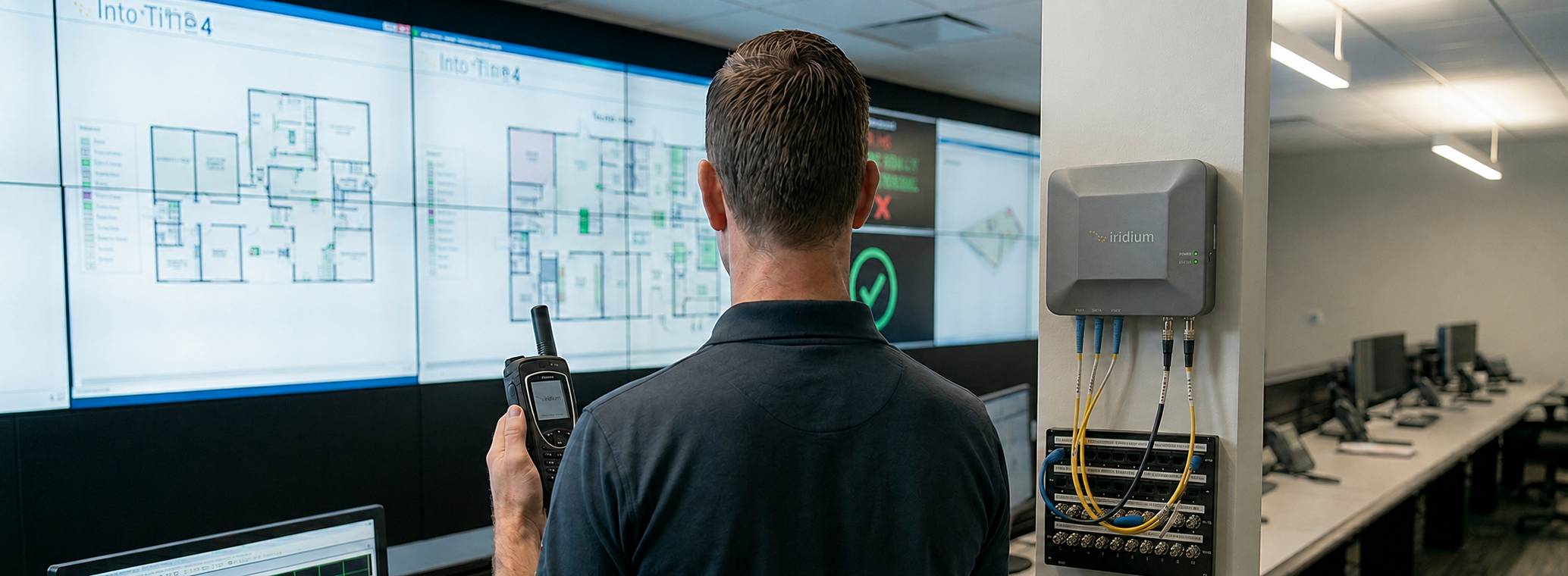
This approach is commonly implemented using technologies, such as an Iridium repeater, a dedicated Iridium indoor repeater, or other engineered signal-distribution architectures. These Iridium repeater solutions enable signals received from outdoor antennas to be distributed throughout operational areas where direct satellite visibility is unavailable.

For facilities that depend on continuous indoor Iridium communication, repeaters and distributed antenna architectures can help eliminate coverage gaps while supporting reliable access in underground, enclosed, and structurally dense environments.

The Role of RF Over Fiber

As facilities become larger, more secure, and more geographically complex, traditional coaxial distribution methods can become impractical due to signal loss over distance. RF over Fiber provides a highly effective alternative for indoor Iridium communication and other satellite communication indoors applications. By converting RF signals to optical signals for transport over fiber, organizations can distribute satellite connectivity across long distances with minimal signal degradation.

This architecture offers several advantages:

  • Extended coverage throughout large facilities
  • Support for underground and remote operational areas
  • Reduced signal loss compared to conventional cabling
  • Greater flexibility for future expansion
  • Simplified integration into existing communication infrastructure

In many critical facilities, RF over Fiber is used not only to support satellite communications, such as Iridium and Inmarsat, but also to extend GPS and GNSS signals into locations where direct reception is impossible. This enables communications, positioning, timing, and synchronization services to remain available throughout the facility from a common signal-distribution infrastructure.

RF over Fiber also enables antenna placement to be optimized independently from equipment location, providing greater freedom when designing resilient communication networks.

Building Communication Resilience from the Start

Indoor satellite communication failures are rarely caused by satellite technology itself. More often, they result from environmental conditions, infrastructure constraints, and insufficient planning during facility design.

By understanding the challenges created by reinforced structures, underground environments, industrial facilities, and secure operational sites, organizations can develop communication architectures that maintain reliable connectivity where direct satellite access is not possible. Through structured signal distribution, properly engineered Iridium repeater solutions, and RF over Fiber infrastructure, critical facilities can extend satellite communication indoors and ensure dependable coverage when operational continuity matters most.

How Non-Terrestrial Networks Are Strengthening Indoor Communication Resilience

NTN Optical Repeaters and the Future of Resilient Indoor Communications

Communication infrastructure is often taken for granted – until it fails.

During natural disasters, military conflicts, cyberattacks, power failures, or large-scale infrastructure outages, terrestrial communication networks can quickly become unreliable or completely unavailable. Cellular towers may lose power, fiber routes may be disrupted, and overloaded networks can prevent users from accessing emergency services when they are needed most.

At the same time, many people are located inside buildings, underground facilities, transportation hubs, bunkers, industrial plants, or secure operations centers where conventional satellite communication has historically been difficult to access.

This challenge is driving increased interest in Non-Terrestrial Networks (NTN) and advanced indoor satellite repeater technologies that extend satellite connectivity deep into indoor environments.

Global Foxcom’s NTN Optical Repeater solution is designed specifically for this purpose: enabling NTN-compatible smartphones to remain connected indoors even if primary communication networks are down.

Unlike traditional satellite communication systems that require direct sky visibility, RF over Fiber repeater technology allows satellite signals to be distributed throughout a facility while maintaining high signal integrity and operational reliability.

Why NTN Matters for Resilient Indoor Connectivity

Non-Terrestrial Networks are becoming an important part of modern emergency communication infrastructure.

NTN refers to communication systems that operate through satellites or airborne platforms rather than traditional terrestrial cellular networks. As smartphone manufacturers and satellite operators increasingly support direct-to-device satellite connectivity, NTN is moving from a niche capability into a mainstream communication layer.

The key value of NTN lies in redundancy. Terrestrial networks can be affected by:

  • Power outages
  • Fiber backhaul failures
  • Physical infrastructure damage
  • Network congestion
  • Cybersecurity incidents
  • Geographic coverage limitations

Satellite networks provide an independent communication path that can remain operational when ground-based infrastructure is compromised.

However, traditional satellite communication has one major limitation: indoor access.

Historically, satellite systems were designed for open-sky operation. Whether using Inmarsat satellite communication, Iridium services, or GNSS systems, most equipment relied on direct line-of-sight access to satellites. This worked well for maritime, aviation, and outdoor field operations, but created significant challenges for indoor users.

Buildings constructed with reinforced concrete, steel, underground shielding, energy-efficient glass, or secure infrastructure can weaken or completely block satellite signals. This creates a serious communications gap in the places where resilient connectivity is often needed most, including:

  • Underground command centres
  • Airports and aircraft hangars
  • Industrial facilities
  • Transportation tunnels
  • Oil and gas installations
  • Military bunkers
  • High-rise buildings
  • Emergency response centres

Modern NTN-compatible smartphones help address part of the challenge by allowing users to connect directly to satellite networks without relying on dedicated satphones. But the physical limitations of indoor signal propagation still remain.

This is where NTN optical repeater systems become critical.

By extending satellite signals from an outdoor antenna into indoor environments, NTN optical repeaters help make satellite-based connectivity available inside protected, underground, remote, or mission-critical facilities. This makes indoor Inmarsat communication and NTN repeater deployments increasingly important components of resilient infrastructure design.

How RF over Fiber Enables Indoor NTN Connectivity

RF over Fiber technology sits at the core of advanced NTN repeater architecture.

Rather than relying entirely on coaxial cable distribution, RF over Fiber converts radio frequency signals into optical signals for transport across fiber infrastructure. At the destination point, the signal is converted back into RF and distributed indoors.

This architecture offers major advantages for satellite communication environments.

Minimal RF Signal Loss

Traditional coaxial cable experiences increasing attenuation over long distances, especially at higher frequencies. RF over Fiber dramatically reduces transmission loss, allowing satellite signals to be transported across large facilities while maintaining signal quality.

This is especially important for NTN and Inmarsat repeater solutions, where stable signal integrity directly impacts communication reliability.

Flexible Antenna Placement

Because optical fiber can span long distances without significant degradation, outdoor antennas can be placed in optimal satellite reception locations while indoor coverage zones can be extended throughout the facility.

This flexibility is essential for:

  • Large facility communication systems
  • Underground installations
  • Multi-building campuses
  • Transportation infrastructure
  • Military facilities

Electromagnetic Immunity

Fiber infrastructure is immune to electromagnetic interference (EMI), which is particularly valuable in industrial, aviation, and defense environments where RF noise can impact conventional systems.

Improved Lightning Protection

RF over Fiber systems provide electrical isolation between indoor and outdoor equipment. This helps reduce vulnerability to lightning strikes and electrical surges – a major operational advantage for exposed rooftop antenna installations.

Scalable Coverage Expansion

As communication requirements evolve, RF over Fiber infrastructure can be expanded more easily than traditional coaxial architectures. Additional indoor zones, antennas, or coverage areas can be integrated without redesigning the entire system.

These benefits make RF over Fiber especially well suited for advanced Inmarsat repeater deployments and NTN indoor communication systems.

How NTN Optical Repeaters Work

An NTN Optical Repeater system typically includes:

    • Outdoor rooftop satellite antennas
    • RF over Fiber optical transport units
    • Indoor distribution equipment
    • Coverage antennas
    • Power and monitoring systems

    The process works as follows:

    1. Outdoor antennas receive satellite signals with clear sky visibility.
    2. RF signals are converted into optical signals.
    3. Optical fiber transports the signals into the facility.
    4. Indoor units reconvert the signals back into RF.
    5. Indoor antennas distribute NTN coverage throughout the protected area.

    The result is seamless indoor satellite communication coverage without requiring users to move outdoors.

    Global Foxcom’s NTN Optical Repeater solution is specifically designed to support NTN-compatible smartphones in indoor environments during communication outages or emergency situations.

    Why NTN-Compatible Smartphones Change the Equation

    One of the biggest shifts in the satellite communication industry is the emergence of NTN-compatible smartphones.

    Previously, satellite communication typically required dedicated satphones or specialized terminals. Today, standard smartphones are increasingly being designed to support satellite-based emergency messaging and communication services.

    This evolution fundamentally changes how organizations think about emergency communication infrastructure.

    Instead of equipping only select personnel with dedicated satellite devices, facilities can potentially support broader emergency connectivity for:

    • Staff
    • Emergency responders
    • Operations personnel
    • Security teams
    • Travelers
    • Maintenance crews
    • Government agencies

    When paired with an indoor NTN repeater infrastructure, users can remain connected inside operational areas without needing direct sky visibility.

    In emergency scenarios, this capability can significantly improve:

    • Personnel coordination
    • Situational awareness
    • Emergency response timing
    • Continuity of operations
    • Safety management
    • Infrastructure resilience

    Inmarsat Repeater Deployments Across Critical Infrastructure

    Inmarsat repeater deployments are expanding across a wide range of industries that require resilient indoor communications.

    Aviation and Aircraft Hangars

    Aircraft maintenance operations often require indoor satellite and GNSS access for avionics testing and operational readiness.

    Traditional outdoor-only satellite access forces aircraft to be moved outside hangars for testing procedures, increasing operational costs and delays.

    Fiber-based Inmarsat indoor repeater systems enable testing to occur indoors regardless of weather conditions.

    Defense and Secure Facilities

    Military and government facilities frequently operate inside hardened structures where external communication access is limited.

    Indoor NTN communication systems provide a resilient backup communication layer that remains operational even during infrastructure disruptions.

    Industrial and Energy Facilities

    Oil rigs, manufacturing plants, and utility sites often require communication continuity in harsh or remote environments.

    RF over Fiber-based repeater systems support stable satellite communication while minimizing signal degradation across large industrial sites.

    Transportation Infrastructure

    Rail systems, ports, tunnels, and airports increasingly require redundant communication infrastructure to support operational continuity and emergency coordination.

    Satellite repeaters can extend coverage into areas where terrestrial networks may be unreliable or unavailable.

    Emergency Management Centers

    Hospitals, command centers, and disaster response facilities require uninterrupted communication capabilities during emergencies.

    Indoor Inmarsat communication systems help maintain connectivity even when terrestrial networks become overloaded or fail completely.

    The Growing Importance of Satellite Coverage Zoning

    As indoor satellite deployments become more sophisticated, satellite coverage zoning is becoming an increasingly valuable design strategy.

    Coverage zoning allows operators to tailor signal distribution to different operational areas within a facility.

    For example:

    • Critical command rooms may require redundant high-priority coverage
    • Public areas may require broad but lower-density access
    • Restricted areas may require isolated communication channels
    • Underground sections may require amplified reinforcement

    RF over Fiber architecture makes these zoning strategies easier to implement because optical infrastructure supports flexible signal routing and scalable expansion.

    Coverage zoning also improves operational efficiency by optimizing resource allocation across large facilities.

    RF over Fiber as the Foundation of Resilient Communications

    Many discussions about emergency communications focus primarily on satellites themselves. However, the underlying signal transport infrastructure is equally important.

    Without reliable indoor distribution, even the best satellite network cannot fully support indoor users during emergencies.

    This is why RF over Fiber has become a foundational technology for modern repeater systems.

    Beyond NTN applications, RF over Fiber is widely used across:

    • Satellite ground stations
    • Distributed antenna systems
    • Broadcast infrastructure
    • Defense communication networks
    • Aviation systems
    • Large venue communications

    Its combination of low loss, scalability, EMI immunity, and deployment flexibility makes it uniquely suited for mission-critical communication environments.

    For organizations planning long-term communication resilience strategies, RF over Fiber is no longer simply an optional enhancement – it is increasingly becoming a core infrastructure requirement.

    The Future of Indoor NTN Communication

    As NTN services continue to evolve, expectations for indoor satellite connectivity will rise rapidly.

    Users will increasingly expect their devices to remain connected regardless of whether they are:

    • Inside buildings
    • Underground
    • In tunnels
    • In secure facilities
    • In transportation infrastructure
    • During disasters or outages

    This shift will drive growing demand for:

    • Inmarsat repeater solutions
    • Indoor NTN communication systems
    • RF over Fiber distribution infrastructure
    • Intelligent coverage zoning
    • Large facility communication systems

    Organizations that invest early in resilient indoor communication infrastructure will be better positioned to maintain operational continuity during future disruptions.

    NTN Optical Repeaters represent a major step toward that future – extending satellite communication beyond outdoor-only environments and into the places where reliable connectivity matters most.