
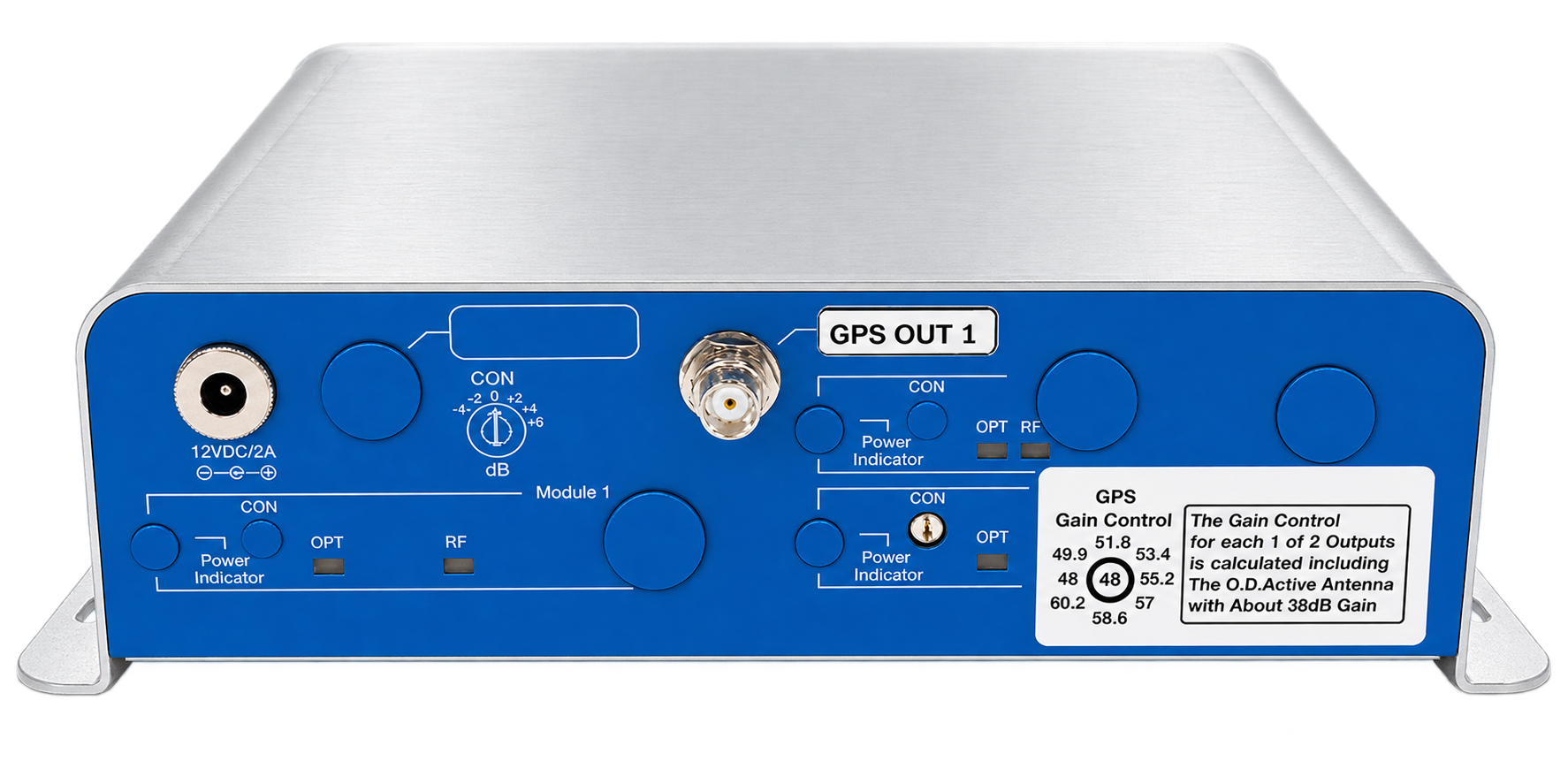
Compact GNSS Optical Link Receiver – Single RF Output
Global Foxcom’s Compact GNSS Optical Link Receiver – Single RF Output provides a dedicated fiber-fed signal path to one GPS or GNSS receiver. It converts the incoming optical signal back to RF and connects directly to the equipment’s antenna port. This point-to-point configuration supports installations requiring a dedicated GNSS connection between a remote antenna location and receiver equipment over fiber distances up to 6km.
Features & Benefits
- Dedicated RF output for one GPS or GNSS receiver
- Direct connection to a compatible receiver antenna port
- Supports GPS, Galileo, GLONASS, and BeiDou services
- 1100–1600MHz RF frequency range
- Variable RF gain up to 44db / 3db optical budget
- Supports fiber transmission up to 6km
- 1310–1550nm optical operating wavelength
- FC/APC optical input and SMA (F) RF output
- Compact 208 × 138 × 50mm enclosure
- 12VDC operation
- Power consumption below 5Watt
- Supplied with 100–220VAC power adapter
- Standard 5-year warranty
This single-output optical receiver provides a dedicated connection between a remote GNSS antenna location and GPS or GNSS equipment through a fiber-based link. It receives the optical signal from the connected transmitter, converts it back into RF, and delivers the recovered GNSS signal directly to the receiver antenna port. This architecture supports installations where antenna placement needs to be separated from navigation, timing, synchronization, or reference equipment.
Designed for direct GNSS connection applications, the receiver supports GPS L1/L2/L5, Galileo, GLONASS, and BeiDou services across a 1100–1600MHz RF range. Variable RF gain enables signal-level adjustment during system commissioning based on optical link loss, RF cable characteristics, and the input requirements of the connected receiver. Compatible antenna options can be selected from the GNSS Antennas category for different installation requirements.
| RF | |
| GPS Support | GPS L1, L2, L5, Galileo E1, E5a+b, GLONASS G1, G2, G5, and BeiDou B1/B2 |
| Frequency Range | 1100–1600MHz |
| RF Gain | Variable |
| GPS RF Gain Range | Up to 44db |
| RF Output Connector | SMA (F) |
| Optical | |
| Operating Wavelength | 1310–1550nm |
| Optical Budget / Fiber Length | Up to 3db (6km of fiber) |
| Optical Connector Type | FC/APC |
| Mechanical & Electrical | |
| Operating Voltage | 12VDC |
| Power Consumption | <5Watt |
| Unit Size | 208 × 138 × 50mm |
How does the Single RF Output receiver connect a remote GNSS antenna source to receiver equipment?
The receiver converts the fiber-delivered GNSS signal back into RF and provides one SMA RF output for direct connection to a compatible GPS or GNSS receiver antenna port. This maintains a dedicated signal path between the remote antenna location and connected equipment.
What equipment can use the recovered GNSS signal?
The RF output is designed for compatible GPS and GNSS equipment that accepts antenna input signals. Applications may include navigation, timing, synchronization, and reference systems.
How does variable RF gain support receiver integration?
Variable RF gain up to 44db enables adjustment of the recovered RF output level during commissioning. The configured level should consider optical loss, RF cable characteristics, and the input requirements of the connected receiver.
Does this receiver provide a GNSS re-radiation output?
No. The RF output connects directly to a compatible GPS or GNSS receiver antenna port. It is designed for direct GNSS connection applications rather than feeding indoor transmit antennas for signal re-radiation.
What factors affect the achievable fiber distance?
The supported fiber distance depends on the total optical link loss, including fiber attenuation, connectors, and other passive optical components. The complete link should remain within the specified 3db optical budget