
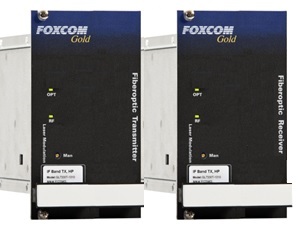
2-18GHz Wideband Optical Link | GL952-218
Global Foxcom’s GL952-218 is a Sat-Light Gold Series wideband optical link for professional microwave applications. It carries RF signals between antenna sites, control rooms, and NOCs over fiber, giving operators a high-performance alternative to coaxial cable and waveguide-based interfacility links.
Features & Benefits
- 2-18GHz RF frequency range
- Optimized for professional microwave applications
- Up to 15 km transmission distance
- Adjustable transmitter and receiver gain control
- Transparent transport of satellite modulation formats
- Reduces attenuation, slope, phase shift, and group delay
- High-efficiency, low-noise analog optical link design
- EAM monolithic laser design for reliable long-distance performance
- Low optical distortion and negligible chirp
- Compatible with all 1st Generation Sat-Light products
- Link gain adjustable from -10 dB to +10 dB
- SFDR performance of 102 dB/Hz2/3 typical
- CNR of 55 dB typical at 36 MHz / 5 GHz
- 50-ohm input/output impedance
- 1550 nm / CWDM optical wavelength
- 12.7–18 VDC supply voltage range
- Compact 5 in. x 3 in. x 5 in. module format
- Standard 5-year warranty
The GL952-218 is built for microwave and satellite infrastructure where wideband RF signals need to move between physically separated antenna and equipment locations. A typical link uses an optical transmitter to receive the RF signal, send it over single-mode fiber, and deliver it to an optical receiver that converts the signal back to RF. This RF over Fiber architecture gives engineers a cleaner way to design long-distance interfacility links while preserving signal quality across demanding microwave environments.
In practical deployments, the GL952-218 supports antenna-to-control-room and antenna-to-NOC connectivity without the cable loss, slope, phase variation, and group delay challenges associated with long coaxial or waveguide runs. Its gain controls, status indicators, low-noise analog design, and Sat-Light compatibility make it suitable for system upgrades, new microwave installations, and satellite communication networks that require reliable wideband transport over fiber.
Basic Details
| RF Specification | Value |
| Frequency Range – Bandwidth | 2-18GHz |
| Amplitude Response @ Unity Gain | ±2dB |
| Noise Figure | 22dB |
| Output IP3 (OIP3) | 15dBm |
| Input Signal Range – Total Power | -5 to -25dBm |
| RF Output Signal Range – Total Power | -5 to -25dBm |
| Optical Specifications | |
| Optical Budget / Distance 1310nm 1550nm | 3dB / 15Km |
Where is the GL952-218 typically used?
The GL952-218 is typically used in microwave and satellite communication networks where RF signals need to travel between antenna sites, control rooms, and network operations centers over fiber.
When is this optical link a better fit than coaxial cable or waveguide?
This link is a strong fit when the installation involves long interfacility runs, signal attenuation concerns, cable routing complexity, or the need to maintain RF performance over distance.
How does the GL952-218 support satellite communication systems?
The link transparently carries satellite modulation formats and supports transport of an entire polarization on each link, making it suitable for satellite IFL and microwave transport applications.
How does gain control support installation and commissioning?
Adjustable transmitter and receiver gain controls enable RF level balancing during setup, giving engineering teams more control over link performance after installation.
What makes the GL952-218 suitable for long-distance microwave transport?
The link uses low-noise analog optical technology, high-performance lasers, and low optical distortion to maintain signal quality across extended fiber runs.
Make an inquiry