
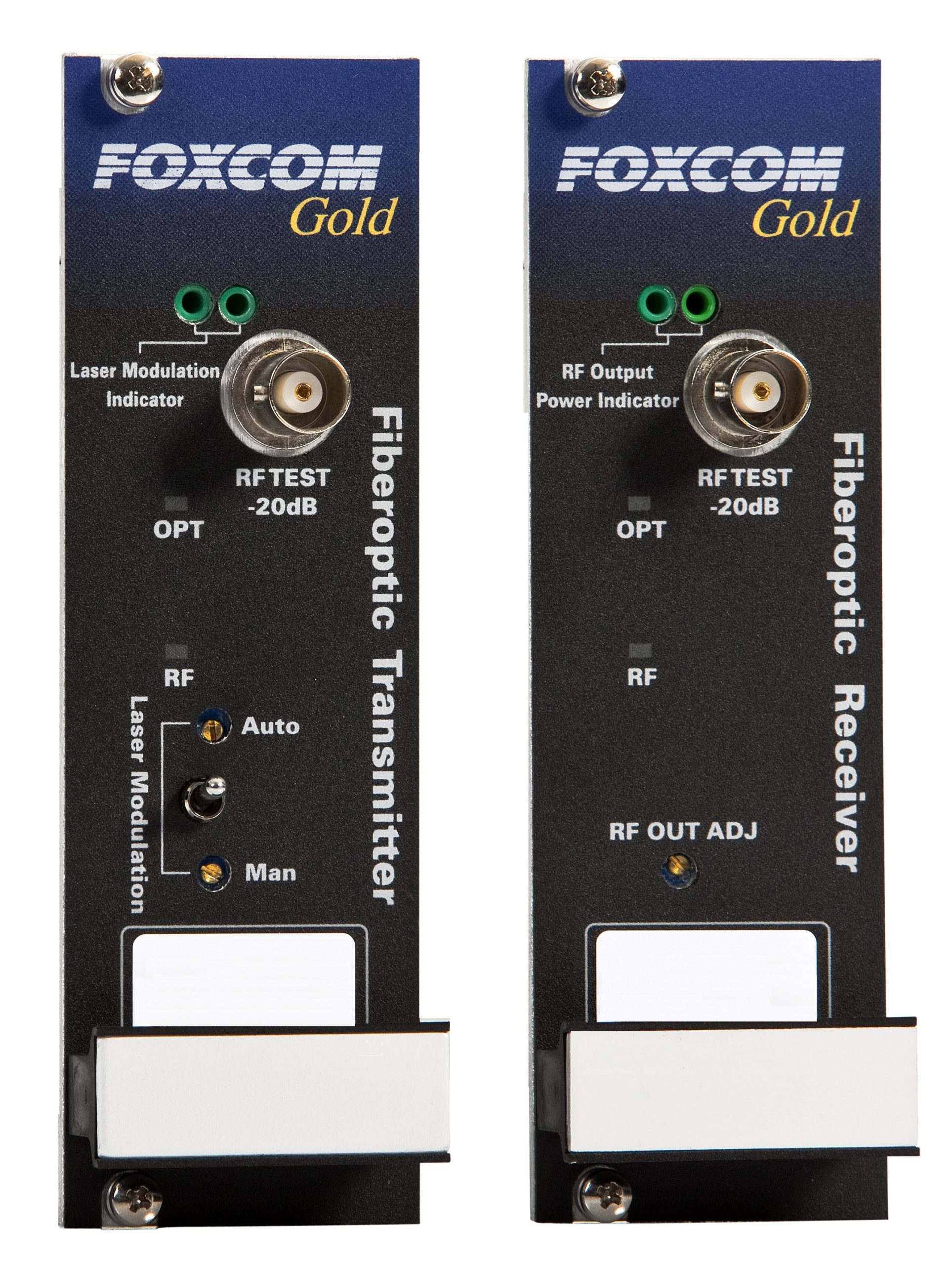
IF Fiber 70/140 MHZ Optic Link | GL7330
The Global Foxcom GL7330 from the Sat-Light Gold Series is a high-performance, cost-effective RF over Fiber (RFoF) optical link engineered to replace conventional coaxial-cabled setups. Designed for demanding satellite uplink and downlink facilities, this system reliably transports IF signals across an extended 10 to 200 MHz frequency spectrum over distances up to 15 km.
Features & Benefits
- Up to 10 km transmission distance over low-loss fiber optic cabling
- High Carrier-to-Noise Ratio (CNR) performance
- Wide dynamic range with a high-performance DFB laser
- Selectable AGC and MGC functionality
- Adjustable link gain from -10 dB to +10 dB
- Supports both 50 ohm and 75 ohm systems
- Backward compatible with legacy first-generation Sat-Light 7000 Series platforms
- Standard 5-year warranty
The Global Foxcom GL7330 provides high-performance Intermediate Frequency (IF) distribution. Operating within the Sat-Light Gold Series, this system mitigates the high attenuation, bulkiness, and signal degradation common to traditional copper-based architectures by moving your critical RF data onto low-loss fiber optics.
By splitting the workload between a high-input optical transmitter (GL7330-T) at the modem side and a rugged optical receiver (GL7330- R) at the Block Upconverter (BUC), the link establishes a highly stable, linear transmission path across distances up to 10 km.
Basic Details
| RF Specification | Value |
|---|---|
| Frequency Range – Bandwidth | 10-200MHz |
| Amplitude Response @ Unity Gain | ±0.4dB |
| Noise Figure | 18dB |
| Output IP3 (OIP3) | 20dBm |
| Input Signal Range – Total Power | 0 to -30dBm |
| RF Output Signal Range – Total Power | 0 to -25dBm |
| Optical Specifications | |
| Optical Budget / Distance 1310nm 1550nm | 4dB (8Km | 15Km) |
Why does the GL7330 support a wider frequency range (10 to 200 MHz) if it is designed for 70/140 MHz IF bands?
The extended bandwidth ensures that the link easily accommodate guard bands, telemetry signals, and non-standard intermediate frequencies without causing edge distortion or roll-off issues. This extra spectral headroom ensures flat amplitude response (±0.4 dB across the full band) for standard 70 MHz and 140 MHz applications.
How does the system handle complex digital modulation schemes without introducing bit error rate (BER) spikes?
The GL7330 utilizes a highly linear, directly modulated Distributed Feedback (DFB) laser. Because DFB lasers inherently possess an ultra-narrow spectral linewidth, the link minimizes chromatic dispersion and maintains exceptional phase stability.
What is the mechanical advantage of installing the GL7330 over traditional high-grade coaxial cables?
Coaxial cables capable of carrying 70/140 MHz signals over long distances are challenged by high attenuation that degrades with temperature fluctuations. The GL7330 replaces these bulky copper lines with lightweight, immune-to-EMI fiber optic cabling, providing a stable 4 dB optical budget that reaches up to 10 km with virtually zero RF signal loss
How does the front-panel test port protect live satellite traffic during troubleshooting?
The system features a built-in, directional -20 dB RF sample port on the front panel. This enables field technicians to plug in a spectrum analyzer or power meter to benchmark performance on the fly. Because the port is isolated, connecting or disconnecting test gear will never disrupt or drop the live signal flowing to the Block Upconverter (BUC).